We are already in a totalitarian experience of children’s literature, just not quite the one Mac Barnett wrote about in Make Believe.
I live in a small town in a deeply red state that has book ban laws. I live in a small enough community that it’s easy to run into my state representatives, which happened a few years ago when the legislature was working hard to pass their book ban legislation.
I told my representative that I was a children’s author and passionate about reading, early literacy, and access to all kinds of information and books, and that I did not support the book ban bill and would like him to oppose it.
My legislator told me that reading was important, that his own daughter struggled to read, but that she was taught to read by reading the Bible.
And dear reader, I thought to myself, maybe that’s why she had a hard time learning to read… I guess it might depend on the translation or version, my own kids had a brightly illustrated children’s Bible, but the Bible is not easy to read right out the gates. It is not what I would hand to someone learning their sight words and establishing their basic vocabulary and word fluency. This is me agreeing with Mac Barnett that this is not an ideal reading scenario for a child—this is definitely an adult reinforcing what they want their child to read and what kind of foundation they would like their child to have. Maybe not all adults start out with the Bible, but oftentimes it is adults that choose and shape that foundation for reading.
Anyway, my representative then went on to tell me that reading is important, but he’s seen the “stuff” that’s in some of these books and it shouldn’t be available to kids. During that legislative session, there was an infamous manila folder that would get passed around at the state legislature with cherry-picked pages and passages to show the kind of “inappropriate” books that were available to kids. It would be like two panels—not even a full page—from Maia Kobabe’s Genderqueer, or a single page from George Johnson’s All Boys Aren’t Blue. Cherry-picked words, scenes, passages to drive their argument, to call books trash, pornography, and harmful to children. To demand a return to “clean” books and classic literature.
My representative unsurprisingly voted in full support of the book ban law that encourages either full removal of “harmful to minors” books or the “harmful to minors” books have to be moved to an area of the library where children cannot access “harmful to minors” materials. The law also allows people to sue the public or school library if books that are deemed “harmful to minors” are not actually relocated or removed.
After the bill became law, some libraries temporarily closed their doors. Some libraries didn’t allow children on entire floors or areas. Some libraries built rooms that you have to be 18 or over to enter and removed hundreds of books from their collections. It is a state that deeply devalues children and their autonomy, but couched behind a demand to “protect” (ie, control) children.
It’s a law that politicizes books, limits access to information, and limits choices that kids have in their reading. My state has dubbed it, “The Children’s School and Library Protection Act.” A very similar name to the current federal legislation pushing for a nationwide book ban that would remove funding for public schools that have books with queer and/or trans experiences on the pages, H.R. 7661, the “Stop the Sexualization of Children Act.” It is not hyperbolic to say that children’s books are under attack from an extremely well-funded and well-coordinated political movement. They also should not be under attack from our National Ambassador of Young People’s Literature.

After a library board election forum that I attended, I was talking to a far-right conservative community member about the book ban law, libraries, and how important access to all books was to me. And he told me, “it sounds like you’re interested in supporting propaganda.”
I feel like this context is important because for the past four or more years I’ve heard politicians and people running for local and state politics, for library and school boards throughout my state talk about the importance of the “right kind of books.”
And I’ve read Mac Barnett’s Make Believe book, and I know that this is not what he means, like I’m fully aware that he is not advocating for book bans, but I also live in a state that is actively trying to limit what books and information are available to read and is openly and aggressively trying to criminalize the trans and queer experience.
So when Mac Barnett calls books books trash, or bad, or crud, he is, my friend, doing the devils work. I know this, because it is literally happening all the time all over the state—and if the people don’t want it, the legislators and lobbyists do.
From a recent library trustee candidate in a nearby especially conservative library district: “I want to bring back traditional, classic, family books that are good for children.”
What is good? Who defines what is a good book? Because library board trustee, Victoria and National Ambassador of Young Peoples’ Literature, Mac Barnett, definitely have very different ideas, even though they might be using the same words.
So when Barnett is being flippant and writes in Make Believe about The Totalitarian Theory of Children’s Literature and works to make a point about what literature is like in a dictatorship or in a totalitarian state—for a lot of us, we are already in that state, beloved.

My so far-right legislature, who can’t even see the repercussions from their own bills, passed a law that inadvertently made giving children band-aids illegal because they didn’t want anyone giving children medical attention or medical advice—it was lobbied as a parent’s rights bill. (They have forgotten this parent’s rights desire when it comes to parents choosing books for their children and book bans, but I digress). This is how much a majority of my state’s legislators hate trans people and were worried about the non-issue of kids seeking medical attention for hormone treatment or to begin to transition prior to turning 18. And then there were the bad bill repercussions of medical examiners not being able to examine kids reporting abuse, inaccessible suicide hotlines, and teachers and school nurses being like, Billy fell on the playground and we can’t provide treatment or give him a band-aid because of this law. I wish I was making this shit up.
Like, Mac Barnett might be joking about a dictatorship and how in a totalitarian government books are used to teach lessons and share desired morals and values, and I am telling you from a deeply red state that we are in a place that is willing to limit, remove, and destroy books, dismantle public and school libraries, and public education to suit the state’s desired morals and values.
So yeah, I understand that Mac Barnett has had enough of books about kindness, but so has Mom’s for Liberty— who are also opposed to books with social emotional learning. But I also live in a state where a teacher was forced to remove a sign that said, “all are welcome here.” So if there is a book about how to be kind to each other that feels moralistic and didactic, I am in full support! I hope that’s a book that can start a good conversation, because the alternative is full on dehumanization.

I, like all children’s book writers I know, want to make well-crafted books for children that I hope children will like and enjoy. I work really hard at it! So do my peers, so despite doing the book banners work for them, it also sucks to be like, hey, we are all trying really hard to not write cruddy books!
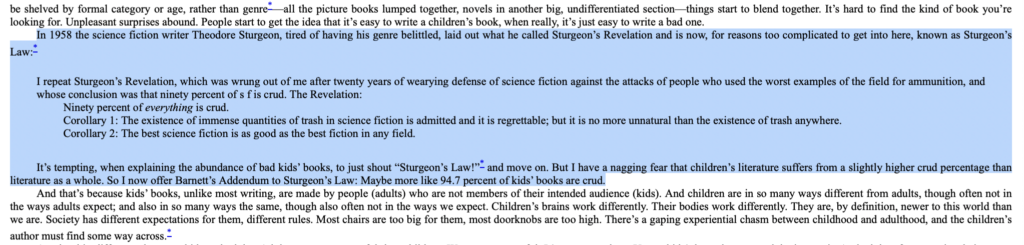
A brief shout out to my queen, Lynda Barry, who wrote the illustrated novel, CRUDDY, which is excellent and disturbing. It’s like if Matilda was for teenagers but instead of being good at reading and moving objects with her mind, she was good at wielding knives and murder because her home life was abusive and terrible.
When people ask me about writing for kids or writing picture books, I tell them that kids are the best audience. They are incredibly imaginative and generous readers, they will go places with you as a reader that an adult or someone who “knows things” will have doubts—but if you build the structure, kids will go all the places. They are wonderful, imaginative, and attentive readers.
This is something that I think Mac and I fully agree on. I also wrote a blog post about play and creativity and writing and you can read that if you need even more unedited thoughts from me. I also include one of my favorite Mac Barnett picture books in that post.
In all this dialogue in Make Believe about didacticism, play, and books that are for children, I think what’s funny is that my second book, The Good Little Mermaid’s Guide to Bedtime, is trying to do a lot of things that Make Believe talks about. Please go buy my book, I am not Mac Barnett, and I absolutely need the book sales. Also forgive me for making this about me, but I think my book does uniquely fit into the conversation, and it’s easier for me to talk about something I have knowledge about— my own book. TGLMGTB has an on purpose didactic text—a nod to the etiquette guides that were the first books for children that Mac also mentions in Make Believe—and to offset that, what I like to think of as a delightfully bad behaved mermaid that is vehemently opposed to following directions. She makes her own rules and lives in her own terrifying imagination, she is what I hope is childlike in the best no rules kind of way. *Spoiler, she does follow instructions, and she does eventually go to bed, but it’s on her own terms, which I think is nice. But I think that means it’s still fairly didactic. I am fine with that.
The original inspiration was to write a mermaid story, but where mermaids are scary and not cute, a story that hints at sirens’ powers and the terrifying myths about mermaids that drown sailors. You know, the kind of thing that should be in a picture book!
What’s fun is the first drafts of this story were even more unhinged then the final published story, and I think it’s a good example of the progression of trying to write something weird and experimental but also adjusting it to fit the market. Because writing picture books or books for children is one thing and publishing is something totally different— something that I think could be examined much more in depth in Make Believe! Writing stories kids want to or need to read is not the same as publishing stories that kids want to or need to read.
I’ve shared the progression and drafts of The Good Little Mermaid’s Guide to Bedtime in presentations, and I don’t know how wise it is to share it online and not behind a paywall or whatever, but let’s have a little conversation about picture book development, craft, and the juxtaposition of didacticism and play.
The first draft of TGLMGTB is from the point of view of a young siren practicing their siren skills and trying to lure the reader into the ocean. It was very fun to write, and I do not think I could sell a book whose pitch is: a mermaid tries to lure and drown the child reader. Experimental, scary, weird, and fun, and maybe also a cause for concern about my mental stability??
Here’s the opening of the first draft of The Good Little Mermaid’s Guide to Bedtime:
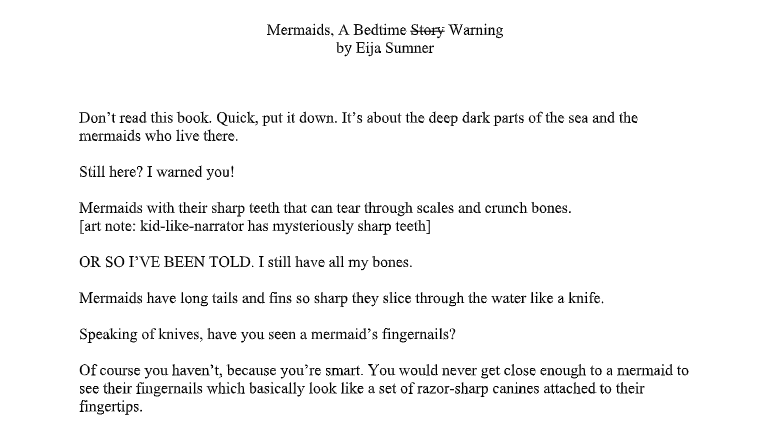
For a lot of reasons, this is something that I would not be able to publish. So, how do I get to a published story from here? How do I start with murder mermaid and get a physical kids book?
Next, I tried writing with a different narrative voice:
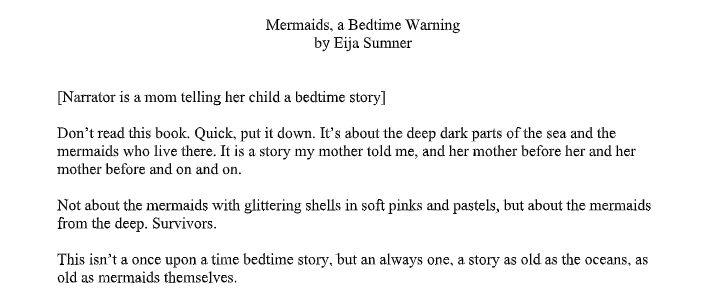
I liked this, but I missed the childlike narrator and voicey-ness, so back to my unhinged voicey talking head mermaid. And the next version, I believe is where we see some progress and where my editor started to see that this could be a book shaped thing to publish instead of a well, that’s nice, but not quite right.
It is my strong opinion that I do not think The Good Little Mermaid’s Guide to Bedtime would have been a book at all, if I didn’t need to turn in a book to my editor, and didn’t already have that relationship. There was a lot of back and forth in trying to make this become a book that I just don’t think would have happened if it was a debut book.
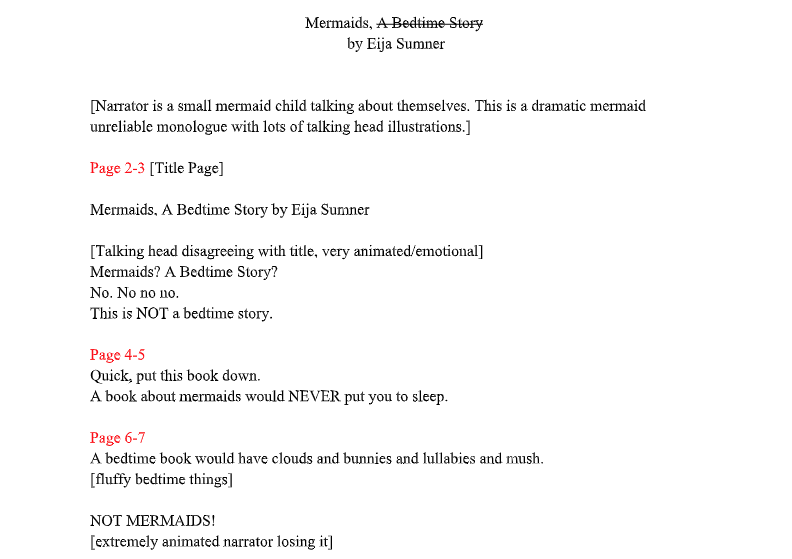
After this draft, my editor and I emailed, I sent her some inspiration from old school Disney movies and old etiquette guides, and there was some amazing artwork on how she thought the book might work and come together on the page:
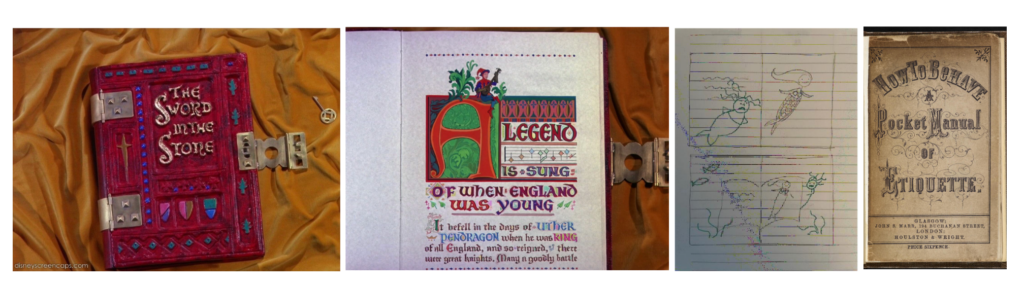
And finally, we get closer to a draft that feels much more in line with the final draft and published story:
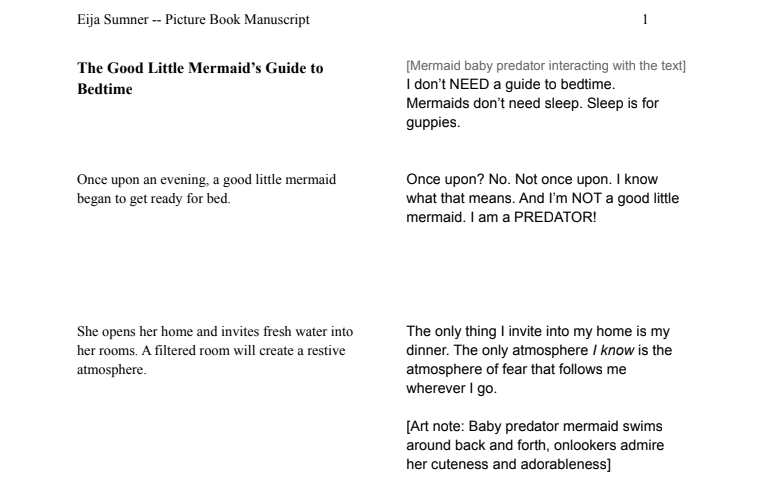
And this is why I brought up my own book in all this mess, because I think it’s fun to see the two writing styles side-by-side. We have the didactic guidebook for bedtime. We have what I hope is my childlike narrator. The message is still, GO TO BED FOR THE LOVE OF GOD, but the mermaid turns the message into something silly and strange and also a little rebellion for the child reader to lean into. I am always hoping that somewhere a kid who likes this book can shout, I AM A PREDATOR, in response to her parents asking her to go to bed.
Back to the writing, it might be fun with whatever you are working on to push the voice both ways just to see what happens. Does your story have a message or lesson or theme? Can you make it more didactic? What happens? What do you notice about the word choice and sentences. Can you make it more childlike? How? In what ways have you invited the child into the story? How has the voice changed, what does the sentence structure and word choice look like? What do you need to carry the story?
In the end, I got to keep my unhinged, predator mermaid. I love her, but in order to keep her predator attitude and aggressiveness, I had to give her something a little more safe to direct that attention towards— the didactic etiquette guidebook. This is a safe choice, this is an adult choice, and it changes where her aggression is focused, so the mermaid isn’t attacking the reader, she’s attacking the rules, the lessons, the didacticism, and that’s something fun for kids to also disagree with—from the safe pages of a book where there are no repercussions. They get to explore the bad behavior without actually behaving badly, which I personally think is really fun place to write from and play with.
I should also point out that being able to write characters from this weird silly place is also a bit of privilege in what I am allowed to write. The mermaid is not the most likable character, and I imagine it would be much more difficult to write characters of kids behaving badly who also read as BIPOC characters. I’m trying to think of a recent example and I cannot?? The most immediate example I can think of is Ezra Jack Keats’ Peter’s Chair, which is such an innocent and sweet story about sibling rivalry and jealousy. Peter does not want to give up all his old things, like his chair to his new baby sister! He runs away, and it isn’t until he realizes that he has outgrown his chair that he makes peace with giving up his old things. That is pretty innocent! Anyway, there is a decent amount of privilege and limited expectations in who gets to write funny or irreverent stories and what those characters can look like.
I am glad my mermaid gets to have her Nathaniel Russell fake flier moment, and I love that for her:
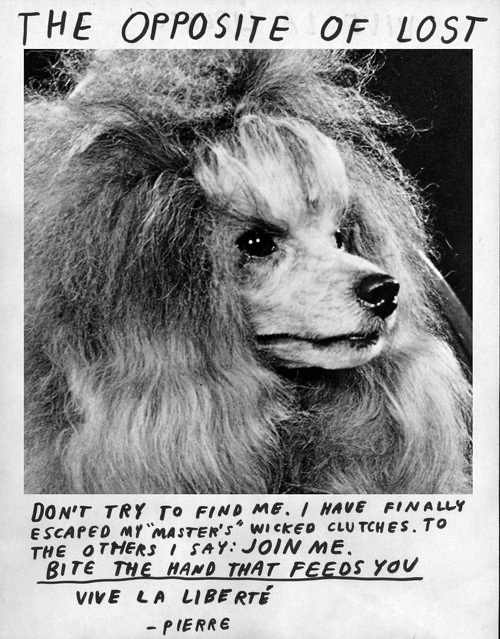
So if we’re talking craft, structure, and publishing—I have a very voicey character. She does kind of follow the rules, she does go to bed by the end of the book. But she remains true to herself, she’s always a little terror of the deep. She’s playful, she’s fun for kids to follow her bad behavior, she says outrageous things that are fun to read aloud. She’s also not for everybody! Which I know from doing so many story times. There are one hundred percent kids and family’s that think this is not a good book. And that’s fine, too. It is not necessarily whether a book is good or bad it’s whether it’s right for an individual reader.
The story needed the didactic book element to give something for my mermaid to rage against— I’m not saying your story also needs a didactic element, but for me, it was a tool that I used to figure out how to have this wild character. In this way, I think it’s a fun book to throw into the conversation— here’s a story for kids that shows a lot of what Mac is talking about with the juxtaposition of the two.
I also think this story’s success (or maybe lack?) suffers from the unlikeable female character acceptance and sales issue—like if I would’ve written about an unhinged boy, I think this story may have done better sales wise?? But who knows, that is a whole other gender criticism lens and discussion!
I’ve also had people tell me that their kids have used the book as their own step-by-step guide for bedtime, so in that sense, this can be a didactic book to go over bedtime routines, expectations, and rules. It’s also a little unhinged with delightful bad behavior—but zero drownings.
Again, I strongly believe this book happened because I was contractually obligated to turn in a book, and I had an existing relationship with my editor. We puzzled this book out, and I’m proud of it, and I think it’s doing some cool things, but I do not think that this would’ve happened without this being a second book and an established editor-author relationship.
Now. Just for a moment, imagine you are Mac Barnett who has published 60 books with wide acclaim, accolades, and book sales up the wazoo. That kind of success allows you to experiment and do fun, weird things more freely. I don’t know what Mac’s rejected manuscripts look like, but the reality is that most Mac Barnett books are “commercial” because they have his name on them, even his more quiet and emotional stories. Mac Barnett’s books are already a success before publication. It is difficult to take his advice or perspective at face value, because I, like many authors I know, have weird, experimental, kid-logic, kid-interest manuscripts— but we are not Mac Barnett. They are not a success before publication, and many will not even make it to publication. Does this make sense?
I don’t think this makes us bitter, it’s just a truth that we know, but I am not sure it is a truth that Mac Barnett realizes his privilege in this regard. Some of us are allowed to play and experiment, and some of us have agents who are leaving the business, or don’t have agents at all, or we have editors who have lost their jobs, or the imprint we published at doesn’t exist anymore, some of us are wondering if we will ever publish another book again, and on a much more serious note, some of us are worried our books will be banned, or that our school visits will be cancelled, or that encroaching totalitarianism will destroy our careers, our livelihoods, and the places that made us readers and writers to begin with.